

Saturday, 18 December 2010

Friday, 17 December 2010
What If.. Final Designs

Website

Blog posts and updates.

Features many photographs of graffiti in Leeds, categorised by their location.

Image enlarged when clicked.

Interactive Google Maps showing its whereabouts.

Poster

Flyers


Presentation Boards
Wednesday, 15 December 2010
What If... Self Evaluation
What problem did you identify?
As a group, our collective theme was the visual landscape in Leeds. Graffiti is a problem all over the UK and most evidently, in Leeds. However, the majority of people ridicule this artform due to its negative associations - it is usually seen in areas where crime is rife, deters businesses from moving into the area etc. We therefore wanted to change the negative stigma into a positive one and try to make the artform more socially acceptable - though not to encourage it.
What evidence did you find to support your decisions?
As a group, we initially looked into graffiti individually to find any important articles, statistics or facts which would help support that this is a current problem which needs to be solved. You can find my research here. Alongside this, Chris and Yafet asked a diverse range of people from all ages their views on graffiti in Leeds to gain insight whether residents believe it is a true problem.
What methods did you use to gather your evidence and what forms did it take?
The majority of our research was secondary and that consisted of looking at news articles, statistics and facts. This originated from the Leeds government website and a wide range of other sites publishing their own findings. Yafet and Chris also asked for peoples views and opinions on graffiti - though no statistical date was involved; this formed our qualitative research. However, we realised that we lacked in primary quantitative research therefore, aforementioned, we devised further surveys and questionnaires to ask the residents on the graffiti what they thought of graffiti through yes or no questions. This enabled us to devise percentages, statistics and figures alongside a specific question which we could then present in an informative way. We also took photographs of graffiti around Leeds to show graffiti is evident and it therefore may be seen as a destructive or negative art form.
What methods of research did you find useful and why?
I believe the primary quantitative research most informative as we could display, effectively and concisely, the true views of people in Leeds and not just the odd, worded opinion we found in a news article from a few years ago. However, there were some facts and statistics which we would be unable to find therefore secondary research proved effective, also.
How did these inform your response to your problem?
We needed the primary research to gain insight into what people thought of graffiti in Leeds. If all the responses proved that no-one deemed it as a negative artform, there was no point trying to solve an unrealistic problem.
What methods did you encounter as problematic?
Although we asked a diverse range of people in Leeds, we could ask even more residents to obtain a more substancial amount of research - however, this was not necessary for this as it was evident that graffiti was deemed a problem. The secondary research was gathered from various sources therefore the content in another may be exaggerated due to the biased nature of the article or the complete opposite etc. We therefore did not know if it was 100% accurate hence why the primary research was the most effective.
How did you overcome this?
Aforementioned, we devised our own surveys and questionnaires and formulated these into charts to display in our presentation.
What research could you have carried out that would have proved more useful?
Although we sourced many worded opinions and factual data, all of this was proving that graffiti was deemed as socially unnaceptable and therefore formed the problem we needed to solve. However, we could have researched the positives in more depth to strengthen our ideas.
Five things that I have learnt about the design process:
1) You should not settle on one idea based on a limited amount of research but explore a range of possible design solutions instead.
2) Gather an extensive amount of research and target a more specific area suited to the problem rather than covering something far too broad and ultimately useless.
3) Research is as important as the final outcome - without proper knowledge, the outcome will not be as successful if you looked at the root of the problem in more depth.
4) Continue researching and gathering information throughout the design process instead of following a forumulated plan i.e. Research for 1 week, development for the next 2 and final outcome for the final week.
5) Gather research from all possible sources - don't rely on websites for information.
As a group, our collective theme was the visual landscape in Leeds. Graffiti is a problem all over the UK and most evidently, in Leeds. However, the majority of people ridicule this artform due to its negative associations - it is usually seen in areas where crime is rife, deters businesses from moving into the area etc. We therefore wanted to change the negative stigma into a positive one and try to make the artform more socially acceptable - though not to encourage it.
What evidence did you find to support your decisions?
As a group, we initially looked into graffiti individually to find any important articles, statistics or facts which would help support that this is a current problem which needs to be solved. You can find my research here. Alongside this, Chris and Yafet asked a diverse range of people from all ages their views on graffiti in Leeds to gain insight whether residents believe it is a true problem.
What methods did you use to gather your evidence and what forms did it take?
The majority of our research was secondary and that consisted of looking at news articles, statistics and facts. This originated from the Leeds government website and a wide range of other sites publishing their own findings. Yafet and Chris also asked for peoples views and opinions on graffiti - though no statistical date was involved; this formed our qualitative research. However, we realised that we lacked in primary quantitative research therefore, aforementioned, we devised further surveys and questionnaires to ask the residents on the graffiti what they thought of graffiti through yes or no questions. This enabled us to devise percentages, statistics and figures alongside a specific question which we could then present in an informative way. We also took photographs of graffiti around Leeds to show graffiti is evident and it therefore may be seen as a destructive or negative art form.
What methods of research did you find useful and why?
I believe the primary quantitative research most informative as we could display, effectively and concisely, the true views of people in Leeds and not just the odd, worded opinion we found in a news article from a few years ago. However, there were some facts and statistics which we would be unable to find therefore secondary research proved effective, also.
How did these inform your response to your problem?
We needed the primary research to gain insight into what people thought of graffiti in Leeds. If all the responses proved that no-one deemed it as a negative artform, there was no point trying to solve an unrealistic problem.
What methods did you encounter as problematic?
Although we asked a diverse range of people in Leeds, we could ask even more residents to obtain a more substancial amount of research - however, this was not necessary for this as it was evident that graffiti was deemed a problem. The secondary research was gathered from various sources therefore the content in another may be exaggerated due to the biased nature of the article or the complete opposite etc. We therefore did not know if it was 100% accurate hence why the primary research was the most effective.
How did you overcome this?
Aforementioned, we devised our own surveys and questionnaires and formulated these into charts to display in our presentation.
What research could you have carried out that would have proved more useful?
Although we sourced many worded opinions and factual data, all of this was proving that graffiti was deemed as socially unnaceptable and therefore formed the problem we needed to solve. However, we could have researched the positives in more depth to strengthen our ideas.
Five things that I have learnt about the design process:
1) You should not settle on one idea based on a limited amount of research but explore a range of possible design solutions instead.
2) Gather an extensive amount of research and target a more specific area suited to the problem rather than covering something far too broad and ultimately useless.
3) Research is as important as the final outcome - without proper knowledge, the outcome will not be as successful if you looked at the root of the problem in more depth.
4) Continue researching and gathering information throughout the design process instead of following a forumulated plan i.e. Research for 1 week, development for the next 2 and final outcome for the final week.
5) Gather research from all possible sources - don't rely on websites for information.
Monday, 22 November 2010
OUGD101 - End of Module Self-Evaluation
Module Code: OUGD101
Module Title: Design Principles
Name: Joe Warburton
Blog Address: http://www.j-warburton1013.blogspot.com
---------------------------------------------------------------------------
1) What skills have you developed through this module and how effectively do you think you have applied them?
Previous to starting this course, I was far more comfortable using computer based programs and software as opposed to hand-rendered media. However, I have experimented using paper crafting and a combination of hand-rendered and computer generated design to create the most effective outcomes in the briefs. For example, the first part of the Alphabet Soup brief required us to create 10 letterforms, at A6 scale, based on the word 'Flatten'. Rather than immediately using the computer to devise the outcome, I used hand-crafting to create the letterforms. This was received well in the crit and I was surprised how pleased I was with the final outcome along with how much I enjoyed using different techniques and processes.
2) What approached to/methods of research have you developed and how have they informed your design development process?
I constantly search for inspiring works which influence my own work in some way - both directly and indirectly. I have referenced some designs as part of the 'What is Graphic Design?' brief as inspiration for my other projects throughout the development process of each outcome but the majority of my research was for the 'No News is Good News' brief as we were required to collect primary research including opinions, facts, words, images and statistics as opposed to design research. This gave me a wider insight into the topic (in this case, Facebook) and rather than following my immediate response to the two briefs, I used the research as reference and a basis for the development phases.
3) What strengths can you identify in your work and how have/will you capitalise on these?
Aforementioned, although I have experimented with hand-rendered processes in these first few projects, I will begin to capitalise and expand my knowledge on computer based software. I am most comfortable with Adobe Photoshop but I believe I have adequate skills when it comes to Adobe Illustrator also, especially after using it for the later briefs.
4) What weaknesses can you identify in your work and how will you address these more fully?
I usually seem to stick with one idea which I think would be the most effective and ignore all other possibilities. However, I need to make sure I explore as many routes as possible in order to devise a wide range of design ideas which I could then choose to develop and explore in more depth. I am not completely happy with my final resolutions as there is always something which I can improve.
5) Identify five things that you will do differently next time and what do you expect to gain from doing these?
1 - Explore many possible routes so I am able to develop some in more depth, thus creating a more thorough body of work.
2 - Plan more ideas on paper rather than developing ideas in my head. I will note down and explore ideas on design sheets so I am able to visualise my thought processes.
3 - Carry a notebook at all times to write/draw ideas, words, things that interest me etc which will all ultimately aid the design process.
4) Blog work/research as soon as possible so posts do not back-date. Although for the majority, I am organised and structured with my work, there are incidents where I realise I should have posted something a while ago. This will make sure I am not wondering whether there is something I need to update.
5) (Will update)
Attendance = 4
Punctuality = 5
Motivation = 4
Commitment = 5
Quantity of work produced = 3
Quality of work produced = 3/4
Contribution to the group = 2
Sunday, 21 November 2010


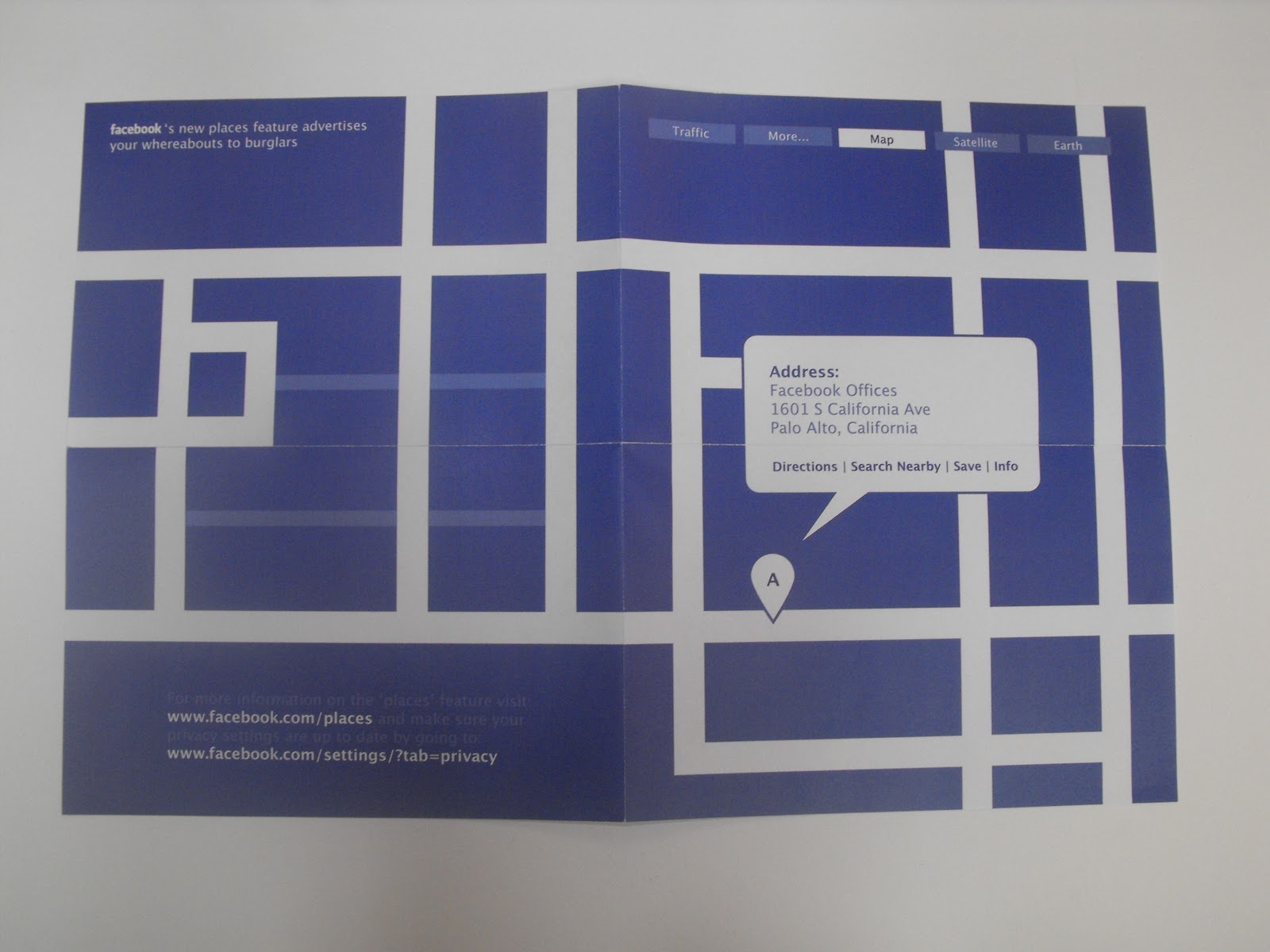

Sunday, 7 November 2010
No News is Good News - Feedback
Rather than our usual crit, we were split into 2 groups and were asked to fill in 2 or more sheets on someone elses work anonymously. This way, you are able to give honest constructive criticism and/or praise without having to tell them directly. These are the 2 feedback sheets I received.


Points I can work on:
- Make sure slight change in colour behind Facebook logo is removed
- Simplify image design for those without any knowledge on this feature


Points I can work on:
- Experiment with different compositions
- Enlarge point size of text


Final outcomes


Subscribe to:
Posts (Atom)